

Key Takeaways
- Master the core cost terms: Your premium buys access to coverage but not free care; deductible, copayment, coinsurance, and out-of-pocket limit determine what you pay for services, with the limit capping your annual spending on covered in-network care (up to $10,600 individual/$21,200 family in 2026).
- Know your plan type: HMO plans offer lower premiums but require networks and referrals; PPOs give more doctor freedom at higher costs; always confirm providers are in-network to avoid surprise bills.
- Check documents and details before care: Use the Summary of Benefits and Coverage (SBC) for costs, verify networks and prior authorizations, and match Explanation of Benefits (EOB) against bills—preventive care is often free if done right.
- Leverage protections and tools: ACA plans cover essential health benefits with no pre-existing condition exclusions; consider HDHPs with HSAs for tax savings, especially with 2026 expansions for some marketplace plans.
If words like deductible, copayment, and coinsurance make your eyes glaze over, you’re not alone. Health insurance can feel hard to read at first, especially when every plan seems full of fine print, cost-sharing rules, and terms no one taught you. Health Insurance Terms are the standardized vocabulary used to describe coverage rules and costs.
That confusion can get expensive. In 2026, health insurance costs have gone up again across employer plans, Medicare, Medicaid, and marketplace coverage, so it’s more important than ever to know what your plan actually pays for, what you’ll owe, and when those costs change. The good news is that health insurance gets much easier to use once you understand a few core ideas.
This guide will help you read your plan with more confidence, avoid surprise bills, and make better decisions about where and when to get care. First, it helps to understand the basic Health Insurance Terms that shape what you pay.
Start with the five Health Insurance Terms that affect what you pay
If health insurance feels confusing, start with the money terms. These five shape most of your costs: premium, deductible, copayment, coinsurance, and out-of-pocket limit. Once you know how they connect, your plan gets much easier to read and use.
Most plans follow the same basic pattern, even though the details vary. You pay each month to keep coverage active, you pay some costs before insurance shares more of the bill through cost sharing, and there is a yearly cap on what you can spend for covered in-network care. If you want a plain-language reference, HealthCare.gov’s cost overview gives a solid starting point.

What your premium pays for, and what it does not
Your premium is the amount you pay each month to keep the plan active. It works a lot like a membership fee. If you stop paying it, your coverage can end.
However, that monthly payment does not mean your care is fully paid for. You usually still have other costs when you use services, such as doctor visits, lab work, imaging, prescriptions, urgent care, or hospital care. That is the part many people miss.
A simple way to remember it is this: the premium buys access to coverage, not unlimited free care. Your plan then applies its own cost sharing rules when you actually get treatment. Those rules can include a deductible, a copayment, or coinsurance, depending on the service.
Paying your premium keeps the insurance on. It does not erase your share of the bill.
This is why a plan with a low monthly premium can still feel expensive when you need care. On the other hand, a plan with a higher premium may lower what you pay later. The right choice depends on how often you expect to use medical care during the year.
How deductibles, copayments, and coinsurance work together
These three terms often show up on the same plan, and they work in stages.
Your deductible is the amount you pay for covered services before the plan starts paying its share for many types of care. Your copayment is a fixed dollar amount, like $30 for a primary care visit. Your coinsurance is a percentage of the cost, such as 20%, after you meet the deductible for services that use coinsurance.
Here is a simple example:
- You have a plan with a $2,000 deductible, a $35 primary care copayment, and 20% coinsurance.
- In January, you see your doctor for a routine sick visit. Your plan may charge only the $35 copayment for that visit, even if you have not met the deductible yet.
- A month later, you need an MRI that is subject to the deductible. If the allowed in-network cost is $1,000, you may pay the full $1,000 because you have not met your deductible.
- Later, you have another covered service that costs $2,000. Since you already paid $1,000 toward the deductible, you may owe the next $1,000 to finish it.
- After that, coinsurance may begin. If a covered service costs $500, you might pay 20%, or $100, and the plan pays the rest.
Plan rules differ, so always check the Summary of Benefits and Coverage. Some services, especially office visits or prescriptions, may have a copayment before the deductible. Many other services do not. For quick definitions, this HealthCare.gov glossary is useful when plan documents get dense.
Why the out-of-pocket limit is one of the most important numbers in your plan
Your out-of-pocket limit (also called the out-of-pocket maximum) is the most you pay in a plan year for covered, in-network care through deductibles, copayments, and coinsurance. After you hit that out-of-pocket limit, the plan pays 100% of covered in-network services for the rest of the year.
That number matters because it shows your worst-case spending for covered care. A deductible tells you when cost sharing changes. The out-of-pocket limit tells you where the pain stops.
For 2026 ACA-compliant Marketplace plans, the federal caps on cost sharing out-of-pocket limits are:
| Coverage type | 2026 Out-of-pocket limit |
|---|---|
| Individual | $10,600 |
| Family | $21,200 |
On family coverage, each person also has an individual cap that cannot be higher than $10,600. Some plans set lower limits, which is better for your budget. Still, no compliant plan can go above those caps. You can confirm the rule in the HealthCare.gov out-of-pocket maximum glossary.
Keep one detail in mind: the out-of-pocket limit usually does not include your monthly premium, out-of-network charges, or services your plan does not cover. So if you want one number to check before you enroll, this is near the top of the list.
Know what kind of plan you have before you book care
Two plans can cover the same doctor visit and still leave you with very different bills. That usually comes down to plan type, not just deductible or copay. Before you book care, check how your plan handles networks, referrals, and out-of-network claims. A five-minute check now can save a long billing mess later.
HMO, PPO, EPO, and POS plans, what changes for your doctor choices
The fastest way to understand these plans is to focus on one issue: how much freedom you have to pick doctors. Some plans keep costs lower by narrowing your choices. Others cost more each month, but give you more room to go where you want.
Here is a simple side-by-side view:
| Plan type | Network rules | Primary care physician | Specialist referral | Out-of-network care |
|---|---|---|---|---|
| HMO (Health Maintenance Organization) | Usually must stay in network | Usually required | Usually required | Rarely covered, except emergencies |
| PPO (Preferred Provider Organization) | More flexible network use | Usually not required | Usually not required | Often covered, but costs more |
| EPO | Must use network providers | Usually not required | Usually not required | Usually not covered, except emergencies |
| POS | In-network works best | Usually required | Usually required | May be covered, but at higher cost |
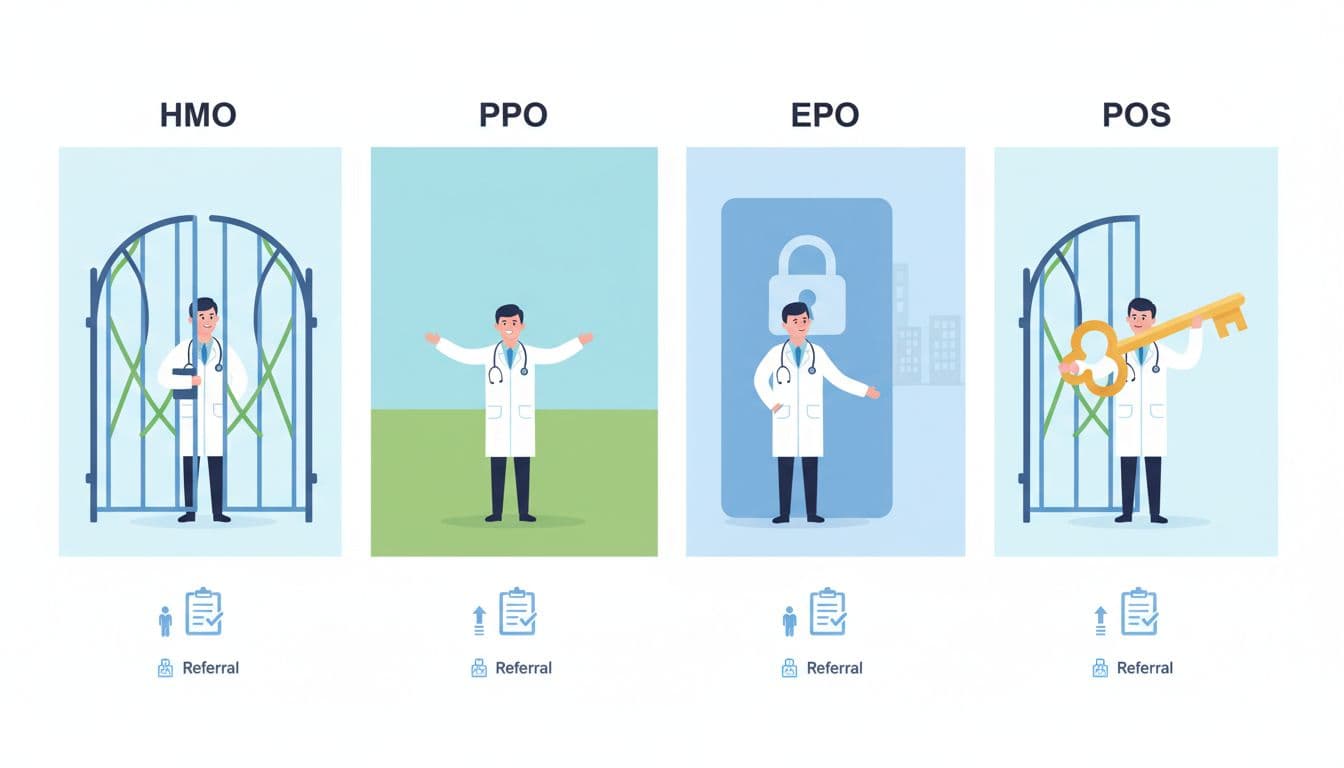
An HMO (Health Maintenance Organization) is often the most budget-friendly option upfront. In return, you usually choose a primary care physician who helps manage your care. If you want to see a skin doctor, heart doctor, or another specialist, your plan will often expect a referral first. If you go outside the network on your own, the plan usually won’t pay.
A PPO (Preferred Provider Organization) gives you the most freedom. You can usually book specialists without a referral, and out-of-network care is often covered at a lower rate. That flexibility is useful if you travel often, already see several doctors, or want more choice. The tradeoff is simple: PPOs often come with higher premiums and higher overall costs.
An EPO lands in the middle. You usually do not need a referral, which is convenient. However, you still need to stay in network for most care. In practice, it can feel like a stricter PPO. Cigna’s comparison of HMO, PPO, and EPO plans gives a clear overview if you want to compare the rules in more detail.
A POS plan mixes parts of an HMO and a PPO. You usually need a primary care physician and referrals for specialists, but the plan may still cover some out-of-network care. Because of that, POS plans can work well if you want some flexibility without paying full PPO prices. Still, the paperwork can be less simple.
Lower monthly cost often means tighter network rules. More doctor choice usually means you pay more for the plan.
So what should you check before booking? Look at your member ID card or insurer app for the plan type. Then confirm your doctor is in-network, whether your plan needs a referral, and whether the facility is also in-network. A plan can approve the doctor but not the lab, imaging center, or hospital tied to that visit.
High-deductible health plans and when an HSA can help
A high-deductible health plan, or HDHP, asks you to pay more out of pocket before the plan starts sharing more of the cost, often through a higher deductible. Because you take on more of the early expense, the monthly premium is often lower. That can look attractive during enrollment, especially if you rarely need care.
For 2026, a plan generally counts as an HDHP if it has at least a $1,700 deductible for self-only coverage or $3,400 for family coverage. These plans also have limits on total out-of-pocket costs, which are $8,500 for self-only and $17,000 for family in 2026, based on the annual IRS limits summarized by Keenan’s 2026 HSA and HDHP update.
The hard part is timing. If you’re healthy most of the year, an HDHP can save money on premiums. But if you need tests, specialist visits, or a surgery early in the year, the upfront bill can sting because you may be paying the full negotiated rate until you meet the deductible.
That is where a Health Savings Account (HSA) can help. It lets you put aside money for qualified medical costs, and that money gets special tax treatment. You can use it for things like doctor bills, prescriptions, and other eligible expenses. If you do not spend it this year, it usually rolls over. A Health Savings Account works best alongside an HDHP to manage those early-year costs.
HSA rules have gotten more attention in 2026 because eligibility expanded. Real-time guidance shows that some Bronze and Catastrophic ACA plans can now qualify for HSA use starting in 2026, which opens the door for more marketplace shoppers. Landmark CPAs’ summary of expanded HSA eligibility in 2026 explains the update in plain language.
If you’re considering an HDHP, ask yourself one practical question: could you handle a larger bill in January or February? If the answer is no, a lower-deductible plan may feel safer, even with a higher monthly premium.
Marketplace metal tiers, Bronze, Silver, Gold, and Platinum
If you shop on the Affordable Care Act marketplace, you will see plans grouped into Bronze, Silver, Gold, and Platinum. These metal levels do not measure doctor quality or hospital quality. They show how costs are split, on average, between you and the insurance company.
Here is the basic pattern:
| Metal tier | Average share paid by plan | What that often means for you |
|---|---|---|
| Bronze | 60% | Lower premium, higher costs when you use care |
| Silver | 70% | Mid-range premium and cost-sharing |
| Gold | 80% | Higher premium, lower out-of-pocket costs |
| Platinum | 90% | Highest premium, lowest costs when care is needed |
HealthCare.gov’s plan category guide confirms that these tiers reflect cost-sharing, not quality. So a Bronze plan and a Gold plan may offer access to the same network and the same essential health benefits, but the way you pay will differ.
Bronze plans usually work best for people who want the lowest monthly premium and do not expect much care. Gold and Platinum plans usually make more sense if you know you will use care often, fill regular prescriptions, or see specialists throughout the year. Silver sits in the middle, and for some buyers it is the sweet spot.
One extra point matters here. If you qualify for cost-sharing reductions, those savings are tied to Silver plans only. That can make a Silver plan a much better deal than it first appears.
You may also see Catastrophic plans. These are generally for people under 30, or for some people 30 and older who have a hardship or affordability exemption. They usually have low premiums and very high deductibles, so they are built more for worst-case coverage than routine care.
Read your plan documents without getting overwhelmed
You do not need to read every page of your plan at once. Start with the documents that answer the money questions first, then check the details before you get care. A few minutes with the right pages can save you from a much bigger headache later.
The Summary of Benefits and Coverage shows the big picture
Your Summary of Benefits and Coverage, or SBC, is the fastest way to size up a plan. It usually lists the deductible, copays, coinsurance, and out-of-pocket maximum near the front, often in a simple chart. It also shows what you might pay for common services like primary care visits, specialist care, urgent care, emergency room care, lab work, imaging, and prescriptions.
Many SBCs also include coverage examples, such as pregnancy or diabetes care, so you can see how costs may work in real life. If you bought coverage through work, look in your benefits portal or enrollment packet. If you bought your own plan, check your insurer account or marketplace documents. HealthCare.gov’s SBC guide shows what this form is meant to include.
Once you find it, save it. Keep a PDF on your phone, email it to yourself, or print a copy for a folder at home. When a bill or claim shows up later, you’ll want that quick-reference page close by.
Check the provider network and prescription drug list before you schedule care
Before you book anything, confirm that the doctor, clinic, lab, hospital, and medication are covered by your plan. This step matters because one in-network part does not guarantee the whole visit is in network. Your doctor may be covered, but the lab down the hall may not be.

Out-of-network care can cost much more because your plan may pay less, or nothing at all, depending on the service and plan type. That is why it helps to check the insurer directory for network providers, the facility name, and your plan’s drug list before the visit. Also confirm your medication tier, since covered drugs can still have very different copays.
Emergency care is the main exception. Under plan rules and federal protections, including the No Surprises Act, emergency services generally cannot be billed at full out-of-network rates the way non-emergency care can. For planned care, though, always verify first.
An Explanation of Benefits is not a bill, but you still need to read it
An Explanation of Benefits, or EOB, is the notice your insurer sends after processing your claim for the medical bill. It is not a bill. Instead, it shows what the provider charged, what your plan allowed, what insurance paid, and what amount may be your responsibility. This Explanation of Benefits is the key document to match against the provider’s bill.

Focus on a few numbers:
- The date of service
- The provider name
- The allowed amount
- The amount insurance paid
- The patient responsibility
Those details help you catch errors, such as duplicate charges, the wrong provider, or a service billed at the wrong network level. Before you pay any provider bill, match it against the EOB line by line. If the bill asks for more than the EOB says you owe, call the provider and your insurer before sending payment. For a plain-language breakdown, CMS offers a helpful guide on how to read an EOB.
What health insurance usually covers, and where gaps often show up
Most health plans cover a wide range of care, anchored by the essential health benefits that serve as a core requirement for many plans, but they rarely cover everything. That is where confusion starts. A service can sound medically useful and still be excluded, limited, or tied to extra rules.
It helps to separate covered benefits from how the plan pays. Your plan may cover a service in general, but only in network, only after you meet the deductible, or only if the insurer approves it first.
The essential health benefits most plans must include
If you have ACA-compliant individual or small-group coverage, your plan must include 10 broad categories of care. HealthCare.gov’s coverage overview and CMS guidance on essential health benefits outline the same core list.
In simple terms, those categories include:
- Outpatient care, such as doctor visits and treatment that does not require a hospital stay
- Emergency services
- Hospital care, including surgery and overnight stays
- Pregnancy, maternity, and newborn care
- Mental health and substance use treatment
- Prescription drugs
- Rehab care and devices, plus care that helps you gain or keep daily skills
- Lab tests
- Preventive care, wellness care, and chronic disease management
- Pediatric care, including dental and vision for children

That protection matters because insurers cannot deny you ACA-compliant coverage because of a pre-existing condition. They also cannot place lifetime dollar limits on essential health benefits. So if you have asthma, diabetes, a past cancer diagnosis, or another ongoing condition, those facts cannot be used to block enrollment in compliant coverage.
Still, the details vary by plan. The category may be covered, but the network, drug list, and cost-sharing rules still decide what you pay.
Services that may not be covered, or may need extra approval
This is where many surprise bills happen. Health insurance plans often include exclusions for services that are not deemed medically necessary under the plan rules.
Common examples include:
- Cosmetic procedures, such as a face-lift or elective body contouring
- Some experimental or investigational treatments
- Certain out-of-network services, especially non-emergency care
- Some non-standard therapies, such as acupuncture or other treatments your plan lists as excluded
- Adult dental and adult vision care on many plans
Even when a service is covered, your insurer may ask for prior authorization. That simply means the plan wants approval before you get the test, drug, or procedure. This often applies to expensive imaging, specialty drugs, hospital stays, or planned surgeries.
Prior authorization is not just paperwork. If you skip it, your plan may refuse to pay, even for care that would otherwise be covered.
Because of that, always ask two things before scheduled care: “Is this covered?” and “Do I need prior authorization?” That small step can prevent a much bigger bill later. For a consumer-friendly overview of Marketplace benefits and limits, KFF’s explanation of covered health benefits is a helpful reference.
Preventive care can save money if you use it the right way
Preventive care is one of the best parts of many health plans, because it can cost you nothing extra when you follow the rules. Annual wellness visits, vaccines, many screenings, and routine preventive counseling are often covered services with no copay, no coinsurance, and no deductible.
The catch is that you usually need to use an in-network provider, and the visit needs to be billed as preventive care. If the appointment shifts into diagnosing a new problem, the billing can change.

For example, a routine annual checkup may be fully covered. But if you also bring up knee pain, need extra lab work for a new symptom, or get a separate problem-focused exam, you could see a charge. The same can happen if a screening test turns into follow-up diagnostic care.
So before your visit, confirm that the provider is in network and ask how the visit will be coded. A little clarity up front helps you keep preventive care low-cost, which is exactly how it is meant to work.
How to avoid surprise bills and get more value from your coverage
Knowing what your plan covers is only half the job. The other half is using that coverage in a way that keeps costs under control. A few simple checks before care, and a few habits during the year, can help you avoid bills that feel random and get more from the plan you already pay for.
The goal is not to memorize every rule. It is to slow down long enough to confirm the details that most often change what you owe. That small pause can save hundreds, and sometimes much more.
Ask these questions before a visit, test, or procedure
Before you schedule care, run through a short mental checklist. First, confirm that the doctor, clinic, hospital, lab, and imaging center are all in network. One covered provider does not always mean the full visit is covered at the in-network rate. That matters most for tests, surgery, and hospital-based care, where outside specialists may be involved.
Next, ask whether the service needs prior authorization, a referral, or any other pre-approval. If your plan requires approval and no one gets it in place, you may get stuck with a denied claim. It also helps to ask for the billing code or service name so your insurer can give a more accurate answer.

Then ask the provider and your insurer for an estimated cost. You want to know:
- what your plan allows for the service,
- how much of your deductible you have met,
- whether you will owe a copay, coinsurance, or both,
- and whether there is a cheaper in-network option nearby.
This is also the moment to ask if the service can be done in a lower-cost setting. A hospital outpatient department may cost more than an independent imaging center or lab, even for the same test. Price transparency rules and federal billing protections make these questions easier to ask, and CMS’s surprise billing guidance is a helpful backup if a bill later looks wrong.
For scheduled non-emergency care, ask one last thing: “Will anyone involved be out of network?” That includes anesthesiologists, pathologists, and radiologists. Under the No Surprises Act, many of these bills are restricted when care happens at an in-network facility, but it is still smart to check early and keep notes.
Common mistakes that lead to higher costs
A lot of costly insurance problems start during enrollment, not at the doctor’s office. One of the biggest mistakes is choosing a plan based only on the monthly premium. A low premium can look great until you need an MRI, specialist care, or regular prescriptions. Then the higher deductible and coinsurance show up fast.
Another common problem is skipping the plan documents. Even a quick read of the Summary of Benefits and Coverage can tell you what you need most: the deductible, out-of-pocket maximum, network rules, and prescription coverage. If you skip that step, you are making a money decision with half the map missing.

Many people also assume a doctor is in network because they saw that doctor last year, because the office says they “take” the insurance, or because the hospital is covered. None of those is enough. Networks change, and “taking” a plan is not the same as being in network for your exact policy. Always double-check in-network status to avoid unexpected charges.
Other costly mistakes build up quietly over time:
- Missing open enrollment or a special enrollment deadline, then getting stuck without the right coverage.
- Failing to track how much of the deductible you have met, so bills feel bigger than expected.
- Ignoring progress toward the out-of-pocket limit, which can affect decisions later in the year.
- Forgetting to review the drug formulary, especially if you take brand-name or specialty medications.
A good habit is to check your insurer portal every month or two. Look at claims, deductible progress, and prescription tiers. It sounds boring, but it works like checking your bank balance. Small reviews help you catch problems before they turn into expensive surprises.
When to call your insurer and what to ask
Call your insurer when a claim is denied, a bill does not match your Explanation of Benefits, a referral seems to be missing, or you cannot tell whether a drug is covered. Those are not small issues to “wait and see” on. The longer they sit, the harder they can be to fix. Review claim details closely to spot discrepancies early.
You should also call if a provider says a service is covered but the claim later says otherwise, or if a hospital bill includes an out-of-network charge you did not expect. If the situation involves emergency care or care at an in-network facility, review your rights under the No Surprise Billing protections from CMS, because some bills should be limited to your normal in-network cost sharing.
When you call, keep the conversation organized. Ask:
- Is this service covered under my plan?
- Was the claim processed as in network or out of network?
- Do you show a referral or prior authorization on file?
- What part of the bill is my responsibility, and why?
- What is the next step if I disagree?
Before you hang up, get the representative’s name, a reference or call number, and a written summary if they can send one through your member portal or email. Write down the date, time, and what you were told. If you need to appeal later, those notes matter.
A clear phone call can often fix a billing problem before it turns into a collections notice. And if it does not, you will already have the paper trail you need to challenge the charge.
Frequently Asked Questions
What is the difference between a copayment and coinsurance?
A copayment is a fixed dollar amount, like $35 for a doctor visit, often due at the time of service. Coinsurance is a percentage of the cost, such as 20%, usually applied after you meet your deductible for certain services. Plans may use one or both depending on the care, so check your Summary of Benefits and Coverage for specifics.
Does paying my premium mean my care is fully covered?
No, your premium is a monthly fee to keep coverage active, like a membership, but it does not cover costs when you use services. You still owe deductibles, copays, or coinsurance based on plan rules until you hit the out-of-pocket limit. Low-premium plans often mean higher costs later if you need frequent care.
What does out-of-pocket limit include and exclude?
The out-of-pocket limit caps what you pay in a year for covered in-network deductibles, copays, and coinsurance—after that, the plan pays 100%. It excludes premiums, out-of-network charges, and non-covered services. For 2026 ACA plans, the max is $10,600 individual or $21,200 family.
How can I avoid surprise medical bills?
Always verify providers, facilities, and medications are in-network before care, and ask about prior authorizations or referrals. Use your insurer app or directory, get cost estimates, and match bills to your EOB. Federal protections like the No Surprises Act limit many emergency and facility-based out-of-network charges.
Conclusion
Mastering key Health Insurance Terms allows for better financial planning. You don’t need to memorize every health insurance rule. However, you do need to know four things: your costs including the deductible, your network, your plan’s Covered services, and where to find the right plan documents when a bill shows up.
That short list can prevent a lot of stress. It can also help you avoid delayed care, surprise charges, and bad plan choices, especially as 2026 costs keep rising and yearly review matters more.
Set aside 20 minutes this week and review your current plan. If you’ve been putting off a visit, test, or prescription because the cost felt unclear, start with your Summary of Benefits and Coverage and your insurer’s provider directory. A little clarity now can make it much easier to get the care you need.
Related Posts